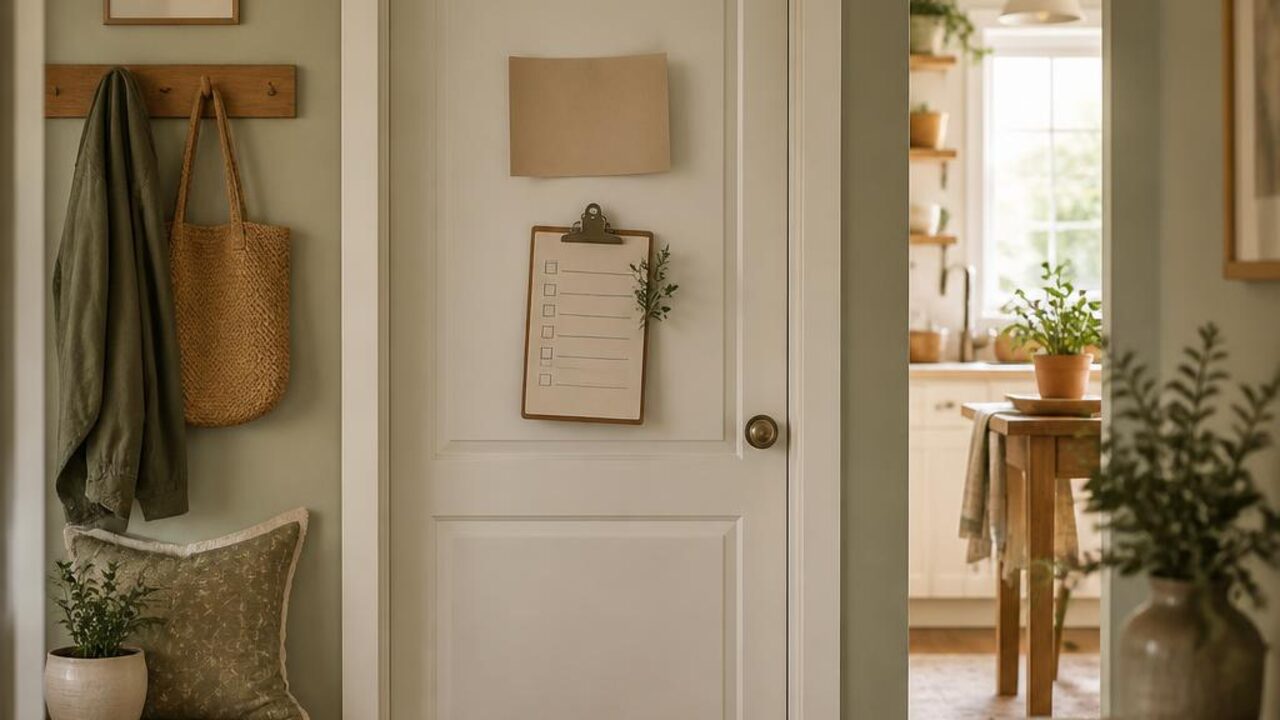

The best low-energy home routine is deliberately small: do a short reset, choose one essential task, and stop when that task is complete. Do not turn an unusually busy day into a test of your character or try to catch up on the whole house at once. A useful routine protects the basics and leaves enough capacity for tomorrow.
This approach works for a day packed with commitments, a week when your schedule keeps changing, or any ordinary day when the full list feels too large. The point is not to lower your standards forever. It is to have a version of home care that still fits when your available energy changes.
Start with a five-minute reset
Choose a reset that makes the next hour easier rather than one that makes the room look perfect. Put away the items blocking a walkway, collect dishes in one place, clear the surface you need for the next meal, or gather laundry without promising to finish it all. Set a short timer if that helps you stop on time.
Keep the reset visible and finite:
- Return obvious items to their usual homes
- Gather rubbish or recycling that is ready to leave the room
- Clear one surface you will use today
- Put supplies for the next task where you can reach them
- Stop when the timer ends, even if the room is not finished
The morning routine guide uses the same principle for the start of the day: a routine should be repeatable on an ordinary, difficult morning, not only on an ideal one.
Choose one essential task
After the reset, ask what will create the most useful relief if it is done today. “Clean the house” is too broad to guide a low-capacity day. “Wash the dishes needed for dinner,” “put clean towels away,” or “send the repair request” describes a finish line.
Choose one task using three questions:
- What becomes harder if this waits until tomorrow?
- What task supports food, hygiene, safety, or a known commitment?
- What can I complete with the time and energy I actually have?
The answer does not have to be the task that looks most impressive. A small practical task that removes a real obstacle is enough. If two items are genuinely time-sensitive, choose the one with the clearest next action and capture the other for later rather than carrying both in your head.
Make the finish line visible
Low-energy plans often fail because “done” keeps moving. Define the smallest complete version before you begin. A kitchen task may be complete when the sink is usable and the counter for food preparation is clear. A laundry task may be complete when one load is dry and in a basket, not when every item is folded.
In Lucru Home, a one-off task can hold the action that needs doing, while recurring cleaning tasks can keep their own room and frequency. Use the right kind of record for the work. A temporary reset does not need to become a permanent daily obligation.
If the task is still too large, split it once:
- “Deal with the mail” becomes “open today's envelopes”
- “Fix the bedroom” becomes “clear the chair”
- “Plan dinner” becomes “choose one meal and check its ingredients”
Do not keep subdividing until planning takes longer than the action. The goal is a start that can become a finish.
Add a stopping point on purpose
A stopping point is part of the routine, not a reward you earn after doing enough. Decide in advance how you will know the reset is complete: the timer ends, the essential task is checked off, or the next meal can happen without extra preparation. Then leave the remaining work for another review.
This boundary prevents a small plan from turning into an accidental cleaning marathon. It also gives you useful information. If the same task keeps carrying over, it may need a smaller definition, a different day, a different owner, or a place in a recurring routine.
Keep tomorrow in view without solving it
Before you stop, write one note for the next useful action if there is one. “Buy detergent” is more helpful than trying to remember why the laundry stalled. “Ask landlord about the leak” gives tomorrow a beginning. Then let the note wait.
The weekly home reset checklist is a better place for broader planning when you have the capacity. Use that review to look at meals, supplies, tasks, and the coming calendar. A low-energy routine should not secretly become a second weekly reset.
A repeatable minimum
Your minimum routine can be as simple as:
- Reset one small area for five minutes.
- Choose one task that protects today's needs.
- Define what complete means.
- Do the task or record the next action.
- Stop and leave the rest for a later review.
The next time the day has more space, you can do more. On a low-capacity day, this version keeps home life moving without pretending that every day has the same shape. Explore the Lucru Home home management app to keep routines, tasks, and household context in one place.